What to Do if Gas Stove Won’t Light

Despite a general dislike for most of the appliances I inherited with my first house, I feel lucky to have a gas stove (or range, as in appliance jargon).

I love cooking, so I appreciate the power and responsiveness of gas.

However, unlike their electric counterpart, gas ranges can’t just be dialed on; their burners must be ignited.

I occasionally struggle with lighting my burners – and I know I’m not alone – so here’s what to check if you’re struggling.

Burner cap
A lot of ignition problems and uneven flames result from food spills and related dirtiness. Routine cleaning and general unslobbiness will avoid this.

After a spill, use a nonabrasive plastic scrubbing pad and mildly abrasive cleanser or soap  to thoroughly clean the cap.

Make sure the cap is completely dry before replacing it over the burner. Take care that alignment pins are lined up with with the cap.

(I know I usually would never say this, but) Don’t put them in the dishwasher.

Burner ports
Burner flames should be about 1″-1.5.” The flame should be blue, not yellow.

If these aren’t the case, your burner ports could be clogged, so you should clean it, following these steps:

  1. Make sure all the controls are off and the stove is cool. Don’t use oven cleaners, bleach or rust remover.
  2. Clean the burner cap as instructed above..
  3. Clean the gas tube opening with a damp cloth.
  4. Replace the burner cap.
  5. Turn on the burner. If the burner does not light, check cap alignment. If the burner still does not light, call appliance service.

Knobs
(This one falls under the “duh” category, but you never know…) Push in the burner knob before turning to light to ensure that it’s set correctly.
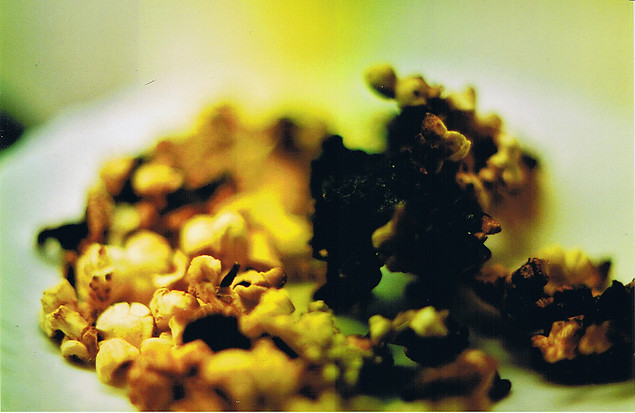
How To Get Rid of Burnt Popcorn Smell in Microwave

Burnt popcorn smell lingers in microwaves so badly, some offices ban it from break rooms. It’s notorious, but completely removable.

If your microwave harbors its own dirty Pop Secrets, try this cleaning tip we got from Frigidaire.

Microwave Odor Removal

You’ll need:

  • 1 cup water
  • juice of 1 lemon
  • grated lemon peel
  • several whole cloves

Combine together in a 2-cup glass measuring cup and boil for several minutes in the microwave on full power. Allow hot mixture to sit in the microwave until cool. Wipe interior with a soft cloth.

Though this tip wasn’t specifically written for burnt popcorn, I can’t think of much else that smells up a microwave. Help me out in the comments below!

Should You Put Aluminum Foil In the Oven?

Maybe your grandma used to use tinfoil to line her oven floor to aid cleanup. But times have changed; tinfoil is no longer made of tin. The stuff you use to shield your ham is actually aluminum foil, which has a lower heat tolerance.

A Case Study on Aluminum Foil in the Oven

Warners’ Stellian‘s expert service guy, Gene, passed on a cautionary tale after he ordered a new, $90 oven floor for a customer.

A well-meaning woman lined the bottom of her oven with aluminum foil, to catch all the food that bakes into the oven.

Instead of having to scrape it all off, she could just pull out the aluminum foil, and voila, no more mess.

Except she ended up with a bigger mess when the aluminum foil melted onto the oven. Turns out the heat tolerance between aluminum foil and tinfoil from the good old days makes a difference.

Aluminum foil-maker Reynolds warns against the practice of lining your oven.

From the Reynolds FAQ webpage:

To avoid possible heat damage to your oven, we do not recommend using aluminum foil to line the bottom of your oven. Rather, we recommend that you place a sheet of heavy duty aluminum foil on the oven rack beneath the pie or casserole you are baking. The foil should be only a few inches larger than the baking pan to allow for proper heat circulation. The foil will catch any drips before they reach the oven bottom.

There you go. Smart play on Reynolds part, right? Because you know people will end up getting rid of the sheet of foil and using a new one next time.

How To Sharpen Garbage Disposal Blades

Just like your kitchen knives, your garbage disposal blades can dull over time from use.

To sharpen the blades, combine table salt and coarse cleanser (we like Bar Keeper’s Friend), shove the mixture down past the baffle (yes, that rubber ruffle-y thing has a name!) and run the disposal without any water. When that’s finished, run water with the disposal like normal and rinse away the residue.

The coarse mixture should sharpen your blades. Another tip: Always run cold, not warm, water when running your disposal. Cold water hardens greasy substances, which makes them easier to grind, and keeps grease from sticking to the drain lines.

Why do front-load washers take so long?

Many customers seem confused when we explain that front-load washing machines need an hour minimum for a normal wash cycle.

Luckily, for times when I can't wait an hour and a half for a clean outfit (sports uniforms, anyone?), I have the 18-minute wash, 18-minute dry feature from Electrolux (though my laundry room looks nothing like this). In a word: lifesaver.

But front-load laundry machines profess great water and energy savings. How does a longer cycle reconcile with such efficiency?

First, front-load washers don’t fill deeply with water, only to dump it all out a short while later. Rather, they pump in a minimal amount of water (some models use sensors to determine the size of the load).

Water continuously filters in and out throughout the cycle, meaning the water stays clean the entire time. Top-load washers fill with water until the clothes float, and then the clothes just sit in that water for the entire cycle.

Also, heating the water often takes longer in a front-loader. A sanitation wash cycle takes about two hours. But you can be assured the hotter temperature eliminates all the cold and flu germs and dust mites congregating in your clothing and linens.

The good news is laundry still takes the same amount of time because dry times have been cut in half. We used to wait for the hour-long drying cycle to finish long after the washer was done. But now, because front-load washers extract so much water during the spin cycle, the average dryer cycle lasts only about 30 minutes.

Or for me, the skinny jeans (which I refuse to put in the dryer because they may get a bit too skinny) I hang on a drying rack easily dry by morning.