Why HE Detergent Is a Must

sudsMore laundry detergent does NOT mean more clean, especially in a front-loading high-efficiency washing machine.

High-efficiency washers use far less water by design than traditional washing machines. Less water and more powerful wash action means less dilution of detergent, leading to overproduction of suds.

High-efficiency detergent (or HE detergent) provides the just right amount of suds to ensure the cleanest clothes possible. HE detergent is labeled “concentrated” or “2x”.”

Make sure to follow the instructions on the label based on load size. And note that tablet laundry detergent isn’t recommended by manufacturers because of issues dissolving in the washer dispenser.

If you don’t use HE detergent,Whirlpool Corp. warns of the following problems:

  • Poor cleaning results.
  • Detergent residue left on clothing.
  • Washer odor due to sudsing residue.
  • Wet clothes at the end of the cycle due to excess suds hindering spinning and draining.
  • Leaking due to excess suds.
  • Extended cycle times or excessive water usage from extra rinsing to remove suds.
  • Error codes.

So remember, less is more.

How Long Does a Dishwasher Last?

dishwash-788494On average, a modern dishwasher lasts 6 to 10 years. When deciding whether to repair or replace your dishwasher, consider its age, original cost and cost to repair. If the repair equals or exceeds half the cost of the dishwasher, consider replacement. Here are some more dishwasher statistics.

215

The number of cycles washed annually by the average dishwasher, according to the U.S. Department of Energy. That’s a little over four cycles per week.

4

How many gallons of water an Energy Star dishwasher uses per cycle.That’s 860 gallons annually.

6

How many gallons of water a standard dishwasher uses per cycle. That’s 1,290 gallons annually.

20

Up to this many gallons of water are wasted by well-meaning homeowners still stuck on pre-rinsing their dishes. Repeat after me: scrape, don’t rinse!

$550

Average price of an Energy Star dishwasher, according to national retail data from 2009.

$538

Average price of a standard dishwasher in 2009.

1.5

Amount of years it takes for the lower operations costs (assuming gas water heating) of an Energy Star dishwasher to make up, or “pay back,” for the initial sticker price difference.

10%/$54

Overall savings of an Energy Star dishwasher over its expected lifetime (assuming electric water heating).

How Long Does a Refrigerator Last?

refrigerator-graveyardAccording to research, the average refrigerator lasts about 12 years. If you think it might be time to retire your refrigerator, check out Energy Star’s Refrigerator Retirement Savings Calculator. This handy tool that lets you input the model number of your current fridge to see how much more you’re spending on energy use annually versus a new, Energy Star refrigerator. Now let’s play by the numbers.

12

The number of years in the average refrigerator’s lifespan, according to research. The life span reflects how long the first owner of a refrigerator used it, which doesn’t necessarily mean that it broke down.

14.75

Amount cubic feet of fresh food storage space in the average refrigerator, based on active models.

6.76

Cubic feet of average amount of freezer space, based on active models. Guess that means the average refrigerator unit is just under 22 cu. ft.

$1,180

Average price of Energy Star refrigerators in 2009.

$1,150

Average price of a standard refrigerator in 2009 (not much difference, eh?).

2.8

Amount of years it takes for the lower operations costs of an Energy Star refrigerator to make up, or “pay back,” for the initial sticker price difference.

$71

Net savings (energy savings minus initial higher cost) of an Energy Star refrigerator over its expected lifetime of 12 years.

Convection oven baking tips

.christmas snowflake food

It's cookie season. Do you need to brush up on your convection baking knowledge?


Are you taking full advantage of your convection oven (if you don’t know what that is, read What is convection?)?

You probably already know to decrease your oven temperature 25 degrees and decrease the bake time about 25 percent for convection oven vs. conventional oven.

But if you already know how to use convection cooking — and you probably do if you partake in holiday baking and cookie exchanges — I bet you’ll still learn something from Dacor’s convection oven baking tips (PDF).

Also, if if your convection oven cooking times seem to be longer now than when you first bought your convection oven, perhaps you need to clean your convection filter.

In a convection oven, the fan draws air through the filter. So especially if you do a lot of roasting,  grease particles will stick to the filter and could obstruct the airflow. Check your use and care manual for instructions on how to clean your filter. Some, like Dacor convection oven filter, are dishwasher safe.

What’s the Ideal Refrigerator Temperature?

Your refrigerator likely comes set at the factory-recommended temperature, probably a “mid-setting,” but what is that?

If you set the temperature too low, your food will freeze. Set it too high, however, and your food will spoil quicker due to increased bacterial growth.

The recommended temperature for your refrigerator ranges from 35 degrees to 38 degrees.

Testing Refrigerator Temperature

But the best test for your refrigerator’s temperature is a beverage. If you don’t like the temperature of your beverage, adjust the fridge. If you think your refrigerator is too cold, increase the temperature by 1 degree and allow 24 hours for the compartment to adjust. Obviously, do the opposite if you think your refrigerator is too warm.

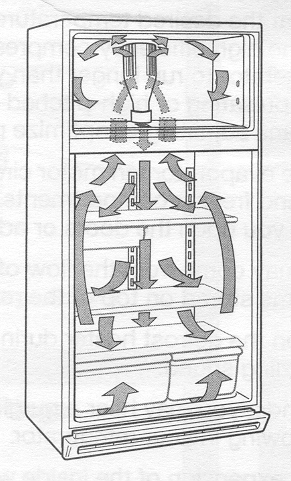
To ensure proper temperatures, air has to be able to flow between the refrigerator and freezer sections.

As shown in the super sweet illustration, cool air from the refrigerator enters through the bottom of the freezer section and moves upward. Most of the air then flows through the freezer section vents and recirculates under the freezer floor. The rest of the air enters the refrigerator section through the top vent and flows down the back of the refrigerator compartment.

Make sure the air vents aren’t blocked by some errant food thing. Otherwise, it might block the flow of air to the refrigerator, which in turn causes temperature and moisture problems and melty ice cream, etc.

Also (word to the wise), if your refrigerator can’t exhaust properly, it can’t cool properly. So, vacuum the condenser every three months!

What’s your ideal refrigerator temperature? Let us know in the comments.