Before you break up with your favorite frying pan over a new induction cooktop, grab the magnet holding up your grocery list. Seriously. It might save you from replacing half your cookware collection.
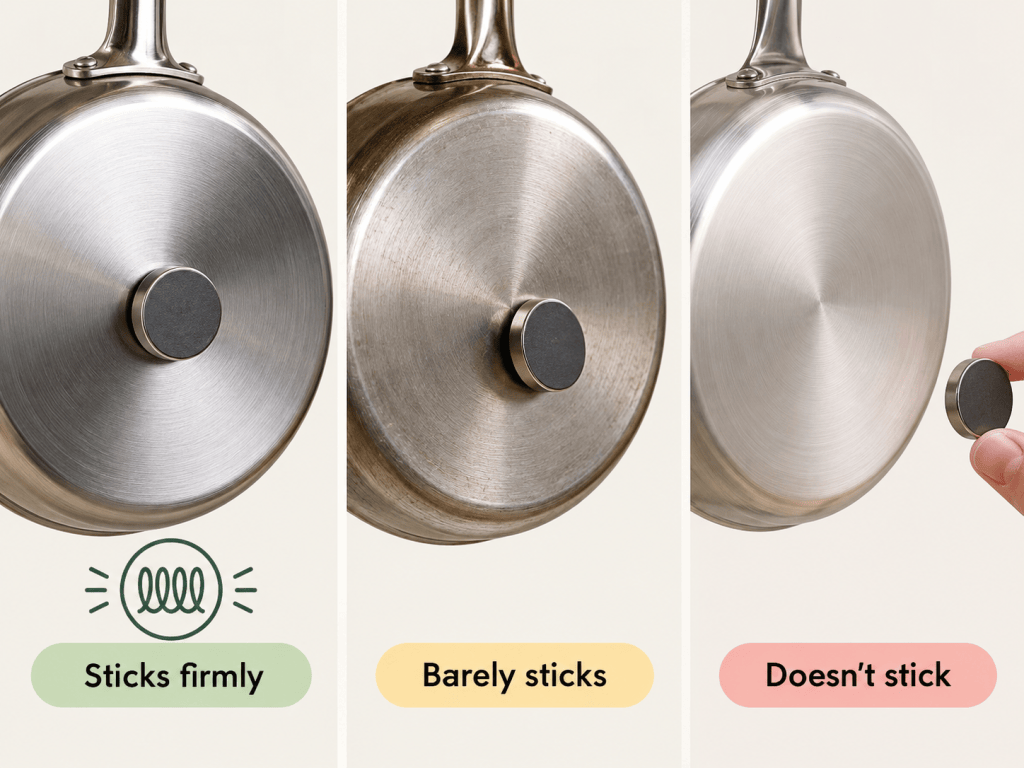
Here’s the quick test: Turn a cool pot or pan upside down and hold a magnet against its flat bottom. If it sticks firmly, the cookware is likely induction-compatible. If it doesn’t stick, it probably won’t work. You’ll also want a flat base that’s appropriately sized for your cooktop’s cooking zone.
The surprising part? Your well-loved cast-iron skillet might pass with flying colors, while that shiny stainless steel saucepan doesn’t make the cut.

What do your magnet test results mean?
Not all magnetic connections are created equal. Here’s what your results can tell you:
- The magnet sticks firmly: Great sign! Your cookware is likely induction-compatible, although the size and shape of its base still matter.
- The magnet barely sticks: Your pan may contain some magnetic material, but it might not heat reliably or be recognized by every induction cooking zone.
- The magnet doesn’t stick: Unfortunately, this pan probably won’t be joining you on your induction cooking adventures.
You can also check the bottom of your cookware for an induction-compatible symbol, which typically looks like a horizontal coil or spring.
And don’t worry if there’s no symbol. Plenty of older pots and pans work on induction, even if they weren’t originally labeled that way.
The magnet test is a great starting point, but there’s a little more to cookware compatibility than meets the eye.
Why does induction cookware need to be magnetic?
Unlike gas ranges, which heat cookware using a flame, or traditional electric ranges, which transfer heat from a hot element, induction uses electromagnetic energy to generate heat directly in compatible pots and pans.
Beneath the glass cooking surface is a coil that creates a changing magnetic field. When compatible cookware is placed above it, that energy generates heat in the cookware itself.
And here’s where induction really shines.
Because the heat is generated directly in the pan, less energy is wasted heating the surrounding air or cooking surface. That’s a big reason induction is more energy-efficient than gas or traditional electric cooking. According to the U.S. Department of Energy, induction cooking can be up to three times as efficient as gas and up to 10% more efficient than conventional smooth-top electric ranges.
That efficiency can also mean faster heating and more responsive temperature control.
But there’s a catch: The cookware needs a suitable magnetic material for the process to work. That’s why some pots and pans work beautifully on induction while others won’t heat up at all.
Which pots and pans work on induction cooktops?
The good news is that you don’t necessarily need cookware labeled “induction-ready.” What matters most is the material used in the bottom of the pan.
Here’s a quick breakdown of common cookware materials.
| Cookware material | Induction-compatible? |
| Cast iron | Yes |
| Enameled cast iron | Yes |
| Carbon steel | Yes |
| Magnetic stainless steel | Yes |
| Non-magnetic stainless steel | No |
| Aluminum | Only with a magnetic base |
| Copper | Only with a magnetic base |
| Nonstick cookware | Depends on the base |
| Glass or solid ceramic cookware | Generally no |
What about stainless steel cookware?
Stainless steel can be a little tricky because not all stainless steel is magnetic.
Some stainless steel cookware is made with a magnetic exterior layer that works with induction. Other varieties contain non-magnetic materials that won’t respond to the cooktop’s electromagnetic field.
Even two stainless steel pans from the same kitchen might give you different results. Rather than assuming stainless steel will work, test each piece individually.
Can you use nonstick cookware on induction?
Absolutely, as long as the pan has a compatible magnetic base.
The nonstick coating doesn’t determine whether the pan will work. It’s the material underneath that matters.
For example, a nonstick aluminum skillet with no magnetic base won’t work on induction. But a similar pan with an induction-compatible stainless steel base can.
The same principle applies to ceramic-coated cookware. A ceramic coating doesn’t automatically make a pan incompatible.
Can cookware pass the magnet test but still have trouble on induction?
Yes, and this is something worth knowing before you make the switch.
A magnet that sticks is an excellent starting point, but it doesn’t guarantee that every pan will heat evenly or work with every induction cooking zone.
A few other details can affect performance.
The magnetic base might be smaller than you think
Some cookware has a magnetic disc attached to the bottom rather than a fully magnetic base.
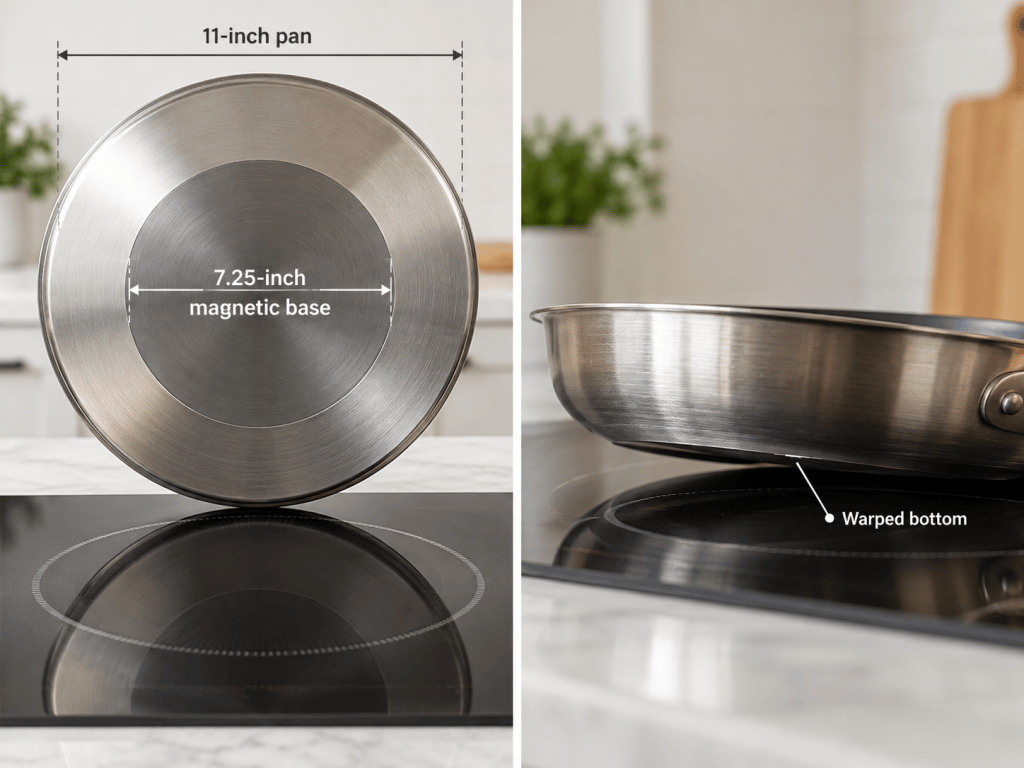
That means a frying pan advertised as 11 inches wide might have a magnetic cooking surface that’s considerably smaller.
For example, GE Appliances explains that an 11-inch frying pan could have a magnetic area measuring just 7.25 inches.
Why does that matter?
Induction cooktops need to detect a sufficiently large magnetic surface before activating a cooking zone. A pan with a small magnetic disc might work on one burner but fail to register on a larger one.
The bottom of the pan might be warped
Induction cookware generally performs best when it has a flat, even bottom. If your favorite frying pan has developed a noticeable wobble over the years, it may not sit properly against the glass cooking surface. That can contribute to uneven heating.
So while you’re checking the magnet, take a moment to inspect the bottom of the pan, too.
What if your induction cooktop won’t recognize a pan?
You’ve tested your cookware, the magnet sticks, and you’re ready to start dinner.
But instead of heating, your induction cooktop flashes an indicator or acts like there’s no pan sitting on it.
Before assuming something is wrong with the appliance, try a few things:
- Double-check the magnetic base. Make sure the magnet sticks firmly to the bottom, not just to a small section.
- Center the cookware. Position the pan over the cooking zone according to your cooktop’s instructions.
- Try another burner. A smaller cooking zone may be better suited to the pan’s magnetic base.
- Check the bottom. Look for significant warping or an uneven surface.
- Consult your owner’s manual. Different induction models have different requirements for cookware detection and error indicators.

If several known-compatible pans won’t work, the problem may involve the cooktop rather than your cookware. Follow the manufacturer’s troubleshooting instructions before considering appliance service.
Do you need to replace all your cookware when switching to induction?
Not necessarily!
Before you start shopping for a brand-new cookware collection, take inventory of what you already own.
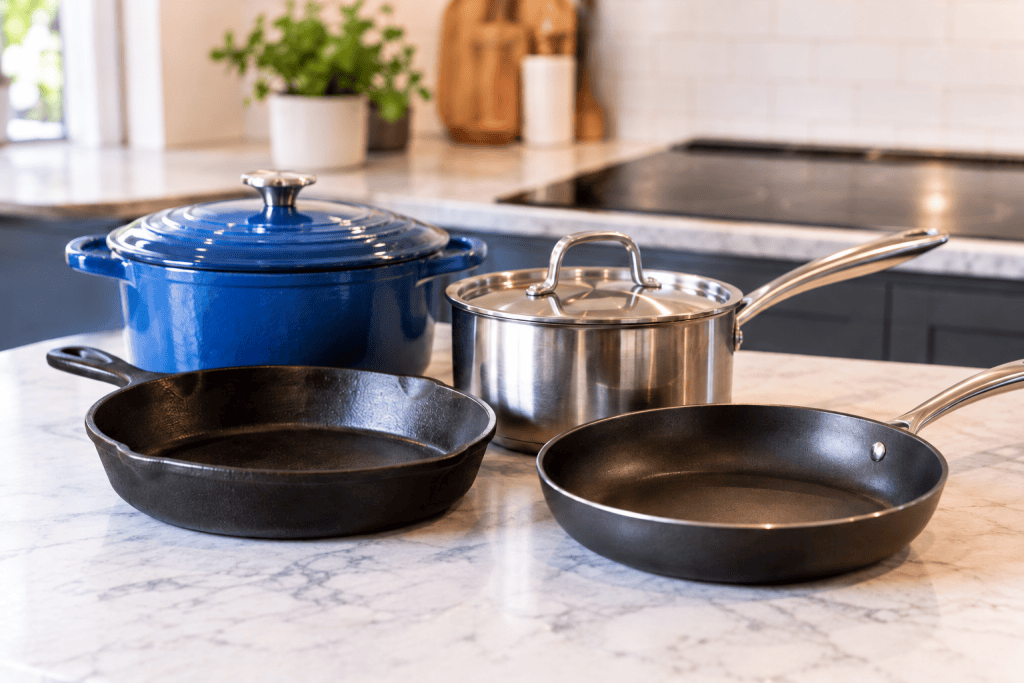
That cast-iron skillet you’ve had for years? It’s probably ready for induction.
Your favorite Dutch oven? If it’s enameled cast iron, it should work, too.
And those stainless steel saucepans you reach for every week might already have magnetic bases.
Rather than replacing everything at once, start by testing the pieces you use most often. You may only need to replace a couple of everyday essentials.
If you’re shopping for new cookware, look for induction compatibility information on the packaging and consider choosing pans with sturdy, flat bottoms that match the cooking zones on your range.
One more tip: Induction-compatible cookware doesn’t have to be expensive. A well-made carbon-steel or cast-iron pan can work just as well with induction technology as a more expensive option, depending on what and how you like to cook.
What about your kitchen’s electrical setup?
Your pots and pans aren’t the only things worth checking before switching to induction. Your home’s electrical setup matters, too.
Many traditional electric ranges use a 40-amp circuit, but some induction ranges require a 50-amp dedicated circuit. Larger models can have even greater requirements. For example, Wolf’s 48-inch induction range requires two separate 50-amp circuits.
Voltage is another consideration, especially in condos and multifamily buildings. While many homes have 240-volt service for their cooking appliances, some buildings supply 208 volts. Certain induction ranges are designed for both, while others may have reduced heating performance at the lower voltage.
And here’s why it’s worth checking before you buy: If your new range requires a different circuit, outlet or wiring, you could be looking at additional installation costs.
Before choosing an induction range or cooktop, compare the manufacturer’s electrical specifications with your existing setup. A qualified electrician can confirm whether modifications are needed.
It’s much easier to address those details while you’re shopping than discover them on delivery day.
Induction cookware FAQs
Can you use an induction adapter plate with regular cookware?
Induction adapter plates are designed to heat on an induction cooktop and transfer that heat to otherwise incompatible cookware.
However, they’re not recommended for every appliance and can reduce some of the efficiency and responsiveness that make induction appealing.
Before using one, check your cooktop manufacturer’s instructions to confirm whether adapter plates are permitted.
Does an induction cooktop stay cool while cooking?
Induction doesn’t heat the glass surface in the same way a traditional radiant electric cooktop does.
However, the cookware itself gets hot and can transfer heat back to the glass beneath it. That means the cooking surface can still be hot enough to cause burns.
Always treat the area beneath a recently used pan as hot until it has cooled.
Why does my cookware make a buzzing or humming sound on induction?
Hearing a little buzz while cooking? That’s actually pretty normal! Induction can cause slight vibrations in cookware, especially pans made with multiple layers of metal. The noise may become more noticeable at higher heat settings. Try adjusting the power slightly if it bothers you.
Your electrical supply is worth considering, too. Some condos and multifamily buildings use 208-volt service rather than 240 volts, which can affect the performance of certain induction appliances. While buzzing alone doesn’t necessarily indicate a voltage problem, unusually loud noises or heating issues are worth checking against the appliance’s specifications.
Can you preheat an empty pan on an induction cooktop?
Be careful with this one. Induction heats cookware quickly, and an empty pan can become extremely hot before you realize it. Excessive heat can damage some cookware, particularly nonstick coatings. Follow your pan manufacturer’s preheating instructions, start with a lower heat setting and avoid leaving an empty pan unattended.
Can you use a wok on an induction cooktop?
Yes, but shape matters. Traditional round-bottom woks generally aren’t suited for standard flat induction cooktops. A flat-bottom wok with a magnetic base is a better option. Some specialized induction cooktops are designed specifically for round-bottom woks, too.
Ready to make the switch to induction?
If you’re considering an induction range or cooktop, there’s more to think about than cookware compatibility. Cooking features, burner size, temperature control and installation requirements can all influence which model makes sense for your home.
Explore our Range Buying Guide to learn more about induction versus gas and traditional electric cooking, or browse induction ranges and induction cooktops at Warners’ Stellian.
Our Appliance Specialists can help you sort through the options and find a range or cooktop that works with the way you actually cook.
